
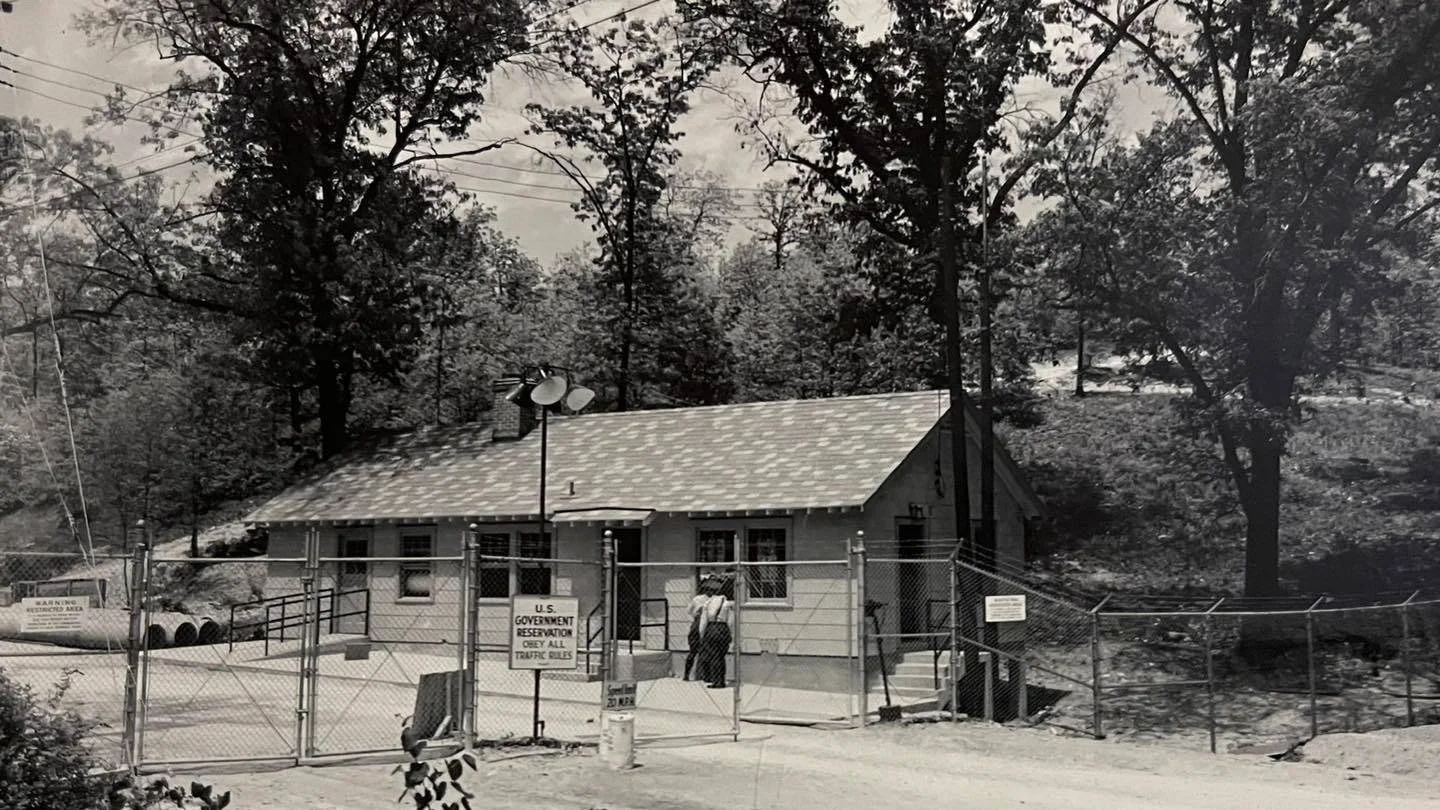
The Tyson History Project is an initiative to preserve, interpret, and communicate the history of Tyson Research Center – both prior to and since WashU’s presence. We are using historical documents and artifacts to develop a more thorough understanding of how the Tyson Valley tract has been used over time. We aim to explore Tyson’s history with particular attention given to the harm caused to both humans and the land.
Recent media coverage
The secrets of bunker 46
Inside a World War II-era bunker at Tyson Research Center, preserved birds, handwritten logs and mold-covered artifacts tell a story of science, stewardship and changing times.
New Grant to Preserve the History of Tyson Research Center
Environmental scientists, humanities scholars, and staff from Tyson Research Center, the Center for the Humanities, and WashU Libraries Special Collections received an Ignite Interdisciplinary Grant for their collaborative project, “Beyond the Bunkers: Excavating the Twentieth Century at Tyson Research Center.” The project employs a public humanities lens to develop a more coherent and comprehensive history of the Tyson Research Center.
Background
While many know Tyson Research Center as a unique ecological research landscape, its historical landscape is just as rich. As Tyson researchers return from the field, it's not uncommon to hear about encounters with building remains or excursions into WWII-era military bunkers in between research tasks. We know the general timeline of the property’s history: from chert surface mining by Indigenous peoples; to early 20th century limestone quarry operations and the small township of Mincke Hollow; to US military ownership and ordnance storage during WWII and the Korean War; and through WashU’s acquisition of the 2,000 acres in 1963.

Construction of a munitions storage bunker in 1942.
There has been some interest in more detailed exploration of Tyson’s history. In the late 1990s, Owen Sexton organized efforts to reconnect with local military veterans who may have worked on site and to find previous inhabitants of Mincke Hollow. On May 2, 1998, Tyson hosted Tyson History Day, a public educational event celebrating the history of the land and asking attendees to share their own recollections. More recently Suzanne Loui has revisited some Tyson historical materials in support of her Environmental Humanities courses. However, there have been no sustained efforts to study the history of the site until 2023.

Dr. Richard Coles (r) with a high school class from Saint Louis Public Schools during a field trip to Tyson in 1982.
With the passing of Tyson’s first director Richard Coles in late 2022, there was renewed interest in understanding all of the activities on site during his stewardship from 1970 to 1995. In preparation for his memorial, Susan Flowers turned to old scrapbooks and photographs, and reconnected with members of the Tyson community from years past. This moment of reflection forced us to confront some very tangible obstacles towards our re-connecting with Tyson’s history: friends of Tyson are aging, and our paper records, abandoned with the turn to digital systems, are deteriorating.
Archival work is a maintenance task, both literally, in physically preserving and organizing our resources, and also, more broadly, in that taking stock of community history becomes about maintaining our sense of identity and purpose. This project is an effort to move Tyson’s research culture towards a stronger historical consciousness, and we intend for these infrastructure-building efforts to support researchers across disciplines for years to come.
1- Archival process and preservation
Our first goal is to organize and re-house the Tyson archival materials, currently stored on site, for streamlined access and safe, long-term storage. University Archivist Sonya Rooney has helped us develop a plan for handling and organizing the archival materials that have been stored in the basement of the Tyson headquarters building. Most materials are being delivered to the University Archives, hosted on WashU’s Danforth Campus, where they will remain safe and accessible to Tyson researchers upon request. During the materials assessment process we are making descriptive spreadsheet entries for the contents of every folder. We are also making electronic copies of the most important materials and uploading them to WashU Box. For organization and accessibility to these digitized items, we are creating entries within a Zotero group library with hyperlinks to the corresponding WashU Box files. Zotero allows us to organize items into different collections, track topics of interest, and provide collaborators with access.
2- Interpretation and communication
Our second goal is to provide full transparency about Tyson’s history that is supported by historical materials and includes important attention to impacts on people and places. Reparative Public Historian Kelly Schmidt is helping us reckon with and write about Tyson’s complex past. We have the following long-term aims in this area:
Construction of an updated and more detailed timeline of Tyson’s history with hyperlinks to supporting materials. The timeline will be a continual work in progress that is publicly available on Tyson’s website.
Collaboration with archivists, historians, researchers, artists, and others – both at WashU and beyond – to make Tyson history investigations sustainable and dynamic.
Consultation with critical interested parties for guidance on our stewardship of the historical sites within the Tyson landscape, most especially those Native Nations with ancestral connections to the area.
Continuing development of history storytelling activities in alignment with our commitment to social justice.
Can you help us?
If you have information about Tyson’s history, we would appreciate connecting with you! Please email Susan Flowers.
Susan Flowers, Kelly Schmidt, Meredith Kelling, Suzanne Loui
Undergraduate research fellows are critical to our progress on the Tyson History Project. The following students have assisted us through the Tyson Undergraduate Fellows Program and the Tyson Environmental Humanities Undergraduate Research Fellowship.
Summer 2023
Grace O’Connor
Washington University in St. Louis, Women, Gender, and Sexuality Studies ‘23
poster
Summer 2024
Emmett Kearns
Washington University in St. Louis, Biology ‘24
poster
Randy Hartmann
Washington University in St. Louis, Environmental Analysis ‘24
Fall 2024
Margaret Beltrami
Washington University in St. Louis, Educational Studies and Environmental Analysis ‘27
Will Corbin
Washington University in St. Louis, Classics ‘26
Spring 2025
Bergen Fields
Washington University in St. Louis, ‘27
Lydia Pita
Washington University in St. Louis, Environmental Studies ‘27
Delia Zacks
Washington University in St. Louis, Math and Economics ‘28
Summer 2025
Tullaia Powell
Iowa State University, Graphic Design with minor in English ‘25
poster
Natalie Reed
University of Illinois Urbana-Champaign, Natural Resources & Environmental Sciences ‘26
poster
FALL 2025
Natalija Grubisic
Washington University in St. Louis, Philosophy with minor in Environmental Studies ‘28
Wesley Huang
Washington University in St. Louis, Women, Gender, and Sexuality Studies with minor in Environmental Analysis ‘28
SPRING 2026
Lucy Baldwin
Washington University in St. Louis, Environmental Biology ’29
Elma Northern
Washington University in St. Louis, Philosophy ’29
Olivia Stokely
Washington University in St. Louis, Political Science ’29
Lissy Portorreal
Washington University in St. Louis ’29
Ailisa McGowan
Washington University in St. Louis, Environmental Science ‘28
Summer 2026
Claire Ackley
Washington University in St. Louis, Environmental Analysis ‘27
Quincy Alberhasky
Brown University, Sociology ‘28
Fadila Lateef
Washington University in St. Louis, Chemical Engineering ‘26