
May 20, 2025
Bird Banding Project at Tyson Research Center Sheds Light on National Migration and Conservation
Deep in the heart of the 2,000 acres of Tyson Research Center, as the early morning light filters through the trees, a dedicated team of bird banders is hard at work. Their mission? To track and study migratory birds, contributing to broader research on bird populations and conservation. Presently led by veteran bird bander Samantha Matchefts, the Migration Population Study builds upon years of research and highlights the ecological significance of Tyson’s green spaces to the greater St. Louis region.
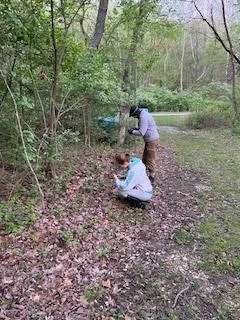
Two team members gently extracting birds from a mist net.
(Photo: Samantha Matchefts)
Originally located at Tyson and known as the Raptor Rehabilitation and Propagation Project, the World Bird Sanctuary (WBS) moved to a 305-acre site next to Lone Elk Park in 2000. In this new location they obtained a federal bird banding permit and began research on migratory birds. Matchefts, who has been involved with WBS since 1991, has played a crucial role in the recent evolution of this bird banding project. The emergence of COVID-19 in 2020 and Highly Pathogenic Avian Influenza (HPAI) in early 2022 forced the program to a temporary halt. The project’s original lead, Linda Tossing, retired at the end of 2021 after years of service, passing the torch to Matchefts just as HPAI surged. Moving the banding project to Tyson was necessary to prevent any risk of exposing WBS’s captive bird population to HPAI while continuing research on wild migratory species. The team was able to resume and re-establish the project at Tyson in 2023 under Matchefts’ leadership. Today, the study requires a substantial volunteer effort, with around 30 WBS volunteers contributing — some since 2005 and others brand new. In order to handle the volume of birds captured, five to seven volunteers are needed daily.
“We collected at least ten years of data at the sanctuary before moving to Tyson, and we’ve already seen notable differences between the two sites.”
“Our study is primarily a population study,” Matchefts explains. “We collected at least ten years of data at the sanctuary before moving to Tyson, and we’ve already seen notable differences between the two sites.” At Tyson, the team uses 14 mist nets placed along the edge of an open field, a shift from the previous site’s heavily wooded setup. Despite using fewer nets, they are capturing more birds — an estimated 1,300 to 1,500 per season, compared to about 1,000 at the sanctuary. Tyson Staff Scientist Solny Adalsteinsson assisted in helping the bird banding team decide on net locations. “Tyson staff scientists learn a great deal about how different species use the landscape through our own research and we love using that knowledge to help other scientists find ideal field sites for their work.” Aldalsteinsson continues, “Studies like Samantha’s are crucial for understanding more about the biology of birds that undergo these amazing migrations every year and for keeping tabs on their populations that are facing myriad threats on their breeding, wintering, and stopover areas.”
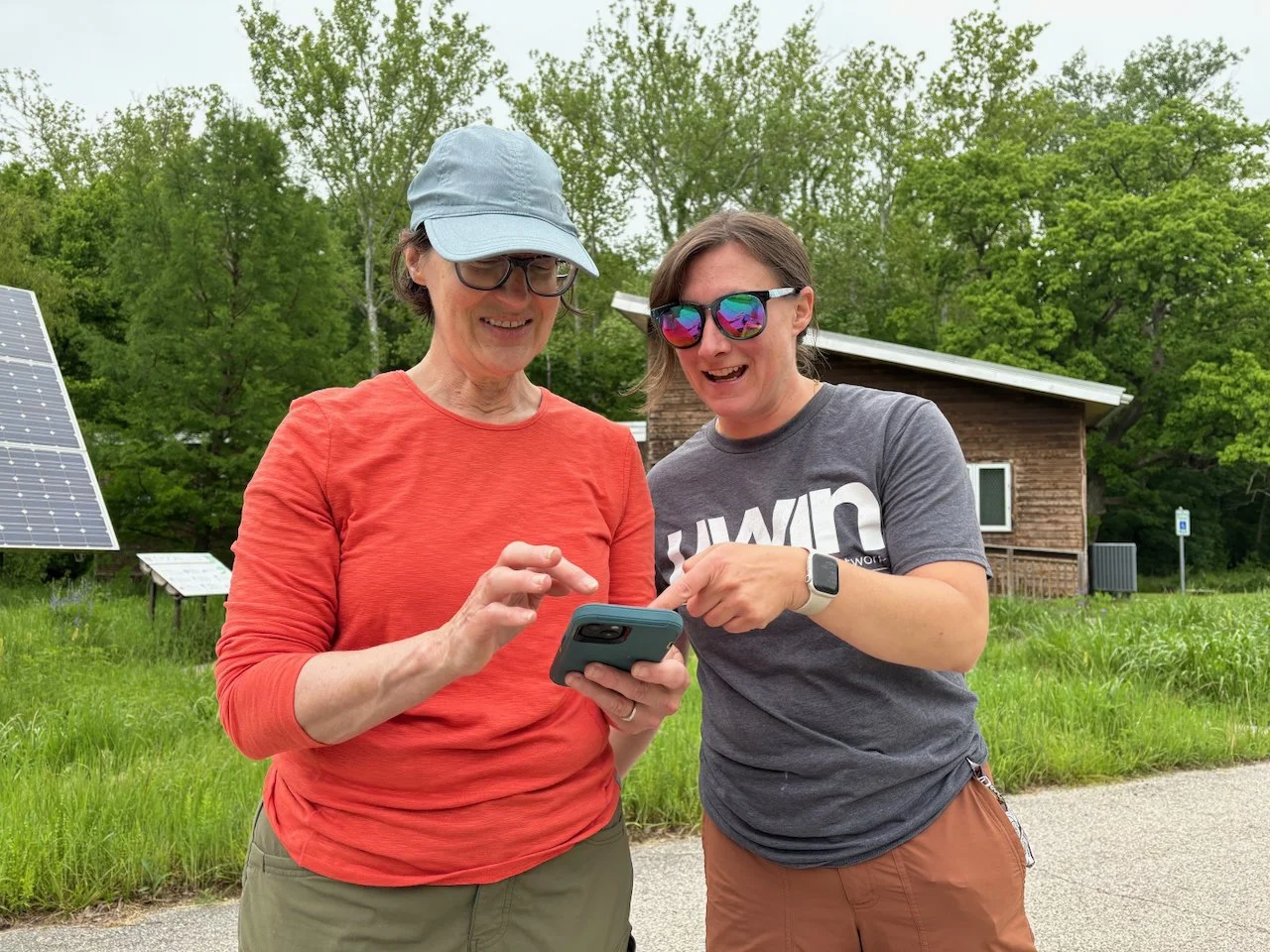
Samantha Matchefts sharing photos of the morning’s banded birds with Tyson Staff Scientist Beth Biro.
(Photo: Susan Flowers)
While there is a difference in number of captures and species caught between the old and new sites, the team bands any bird caught in their nets. Data collected, including species, age, sex, weight, and general condition of the bird, is submitted to the United States Geological Survey (USGS) Bird Banding Laboratory. This information helps track migration patterns and population health, offering insight into ecological trends across North America.
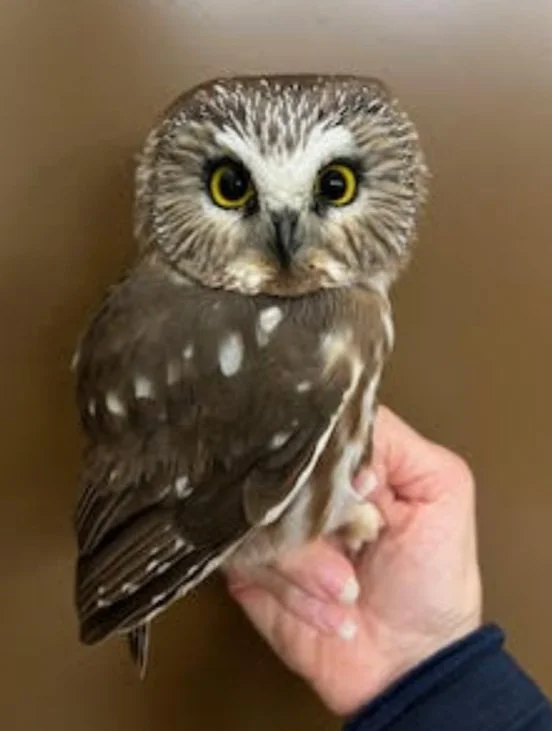
Northern Saw-whet Owl
(Photo: Samantha Matchefts)
The project also includes a fall banding study of the Northern Saw-whet Owl (Aegolius acadicus). Unlike songbird capture, which relies on birds flying into nets naturally, the owl study uses call playbacks to attract these elusive nocturnal birds. The team has experimented with different net locations over the past three years, adjusting strategies to increase their success. One particularly exciting aspect of the owl study has been the recapture of owls originally banded in Wisconsin, providing valuable data on migration routes of the species.
Samantha emphasizes the significance of Tyson’s role as a stopover site for migratory birds. “Studies like ours emphasize the importance of maintaining green spaces,” she says. “By monitoring bird populations, we assess their health, detect parasites, and track long-term trends.” Kim Medley, director of Tyson, stresses this importance, adding, “Field stations can function as both critical habitat for many species and key areas providing opportunities for long-term research. We are very excited that Samantha and her team are able to conduct this important study at Tyson.”
“Field stations can function as both critical habitat for many species and key areas providing opportunities for long-term research. We are very excited that Samantha and her team are able to conduct this important study at Tyson.”
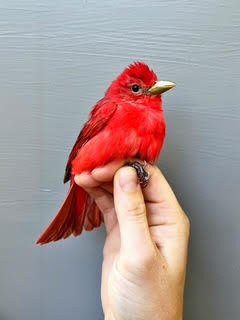
Male Summer Tanager
(Photo: Samantha Matchefts)
Looking ahead, Samantha and her team plan to continue banding at Tyson for at least the next decade. She hopes to reintroduce a fall songbird banding session to further expand their data collection. As they work toward these goals, the team also finds time to enjoy their shared passion — often playing the board game Wingspan during the long waits in bird banding sessions.
For those interested in the intersection of science, conservation, and birdwatching, the bird banding project at Tyson offers a fascinating glimpse into the lives of migratory birds and the importance of preserving their habitats. As the data accumulates year after year, the team’s efforts will continue to inform conservation initiatives on both a local and national scale.
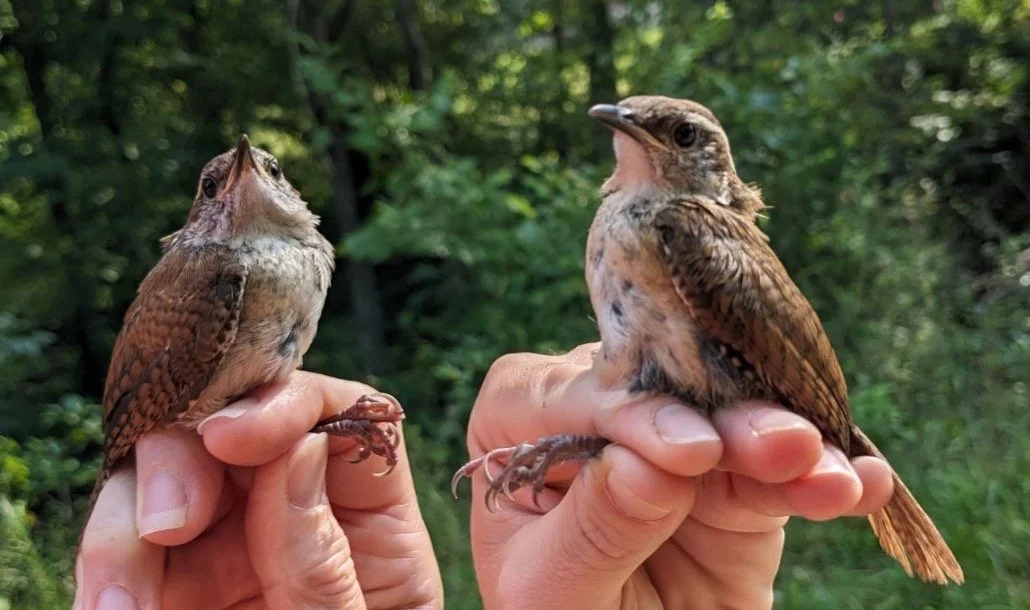
Banner image: Baby Carolina Wrens (Photo: Colleen Crank)
About the author
Melissa Parkinson (she/her) is an undergraduate at Washington University in St. Louis studying Environmental Science and Secondary Education, with a minor in Political Science. She has a strong interest in science communication and education, and is currently serving as Tyson’s Media & Communications Intern.